
Live screen, keyboard and mouse
Pick the quality that fits the moment, switch between displays, and send or fetch the clipboard.
- Auto
- Smooth 60 FPS
- Balanced
- Sharp
- Data saver
In development
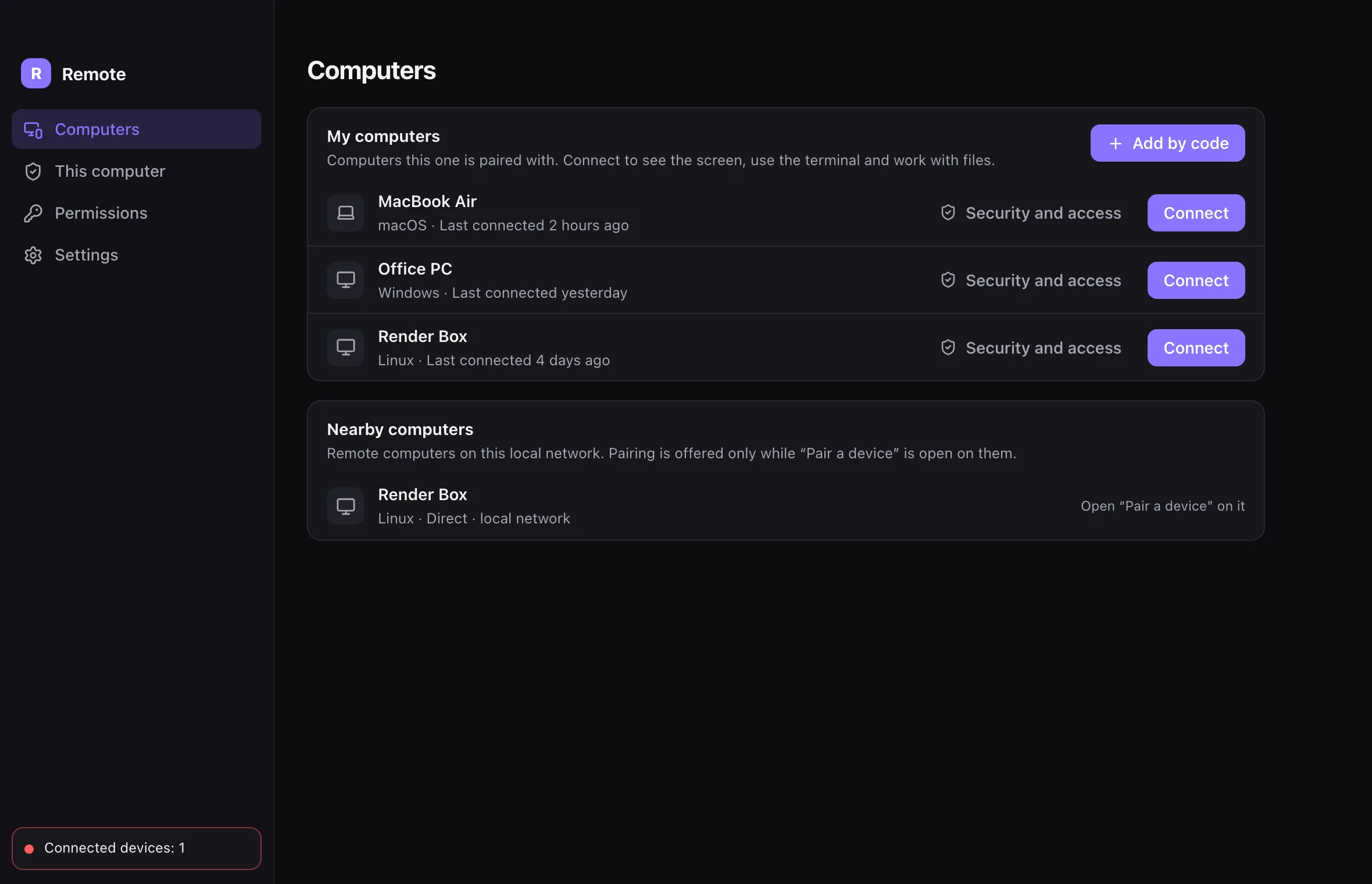
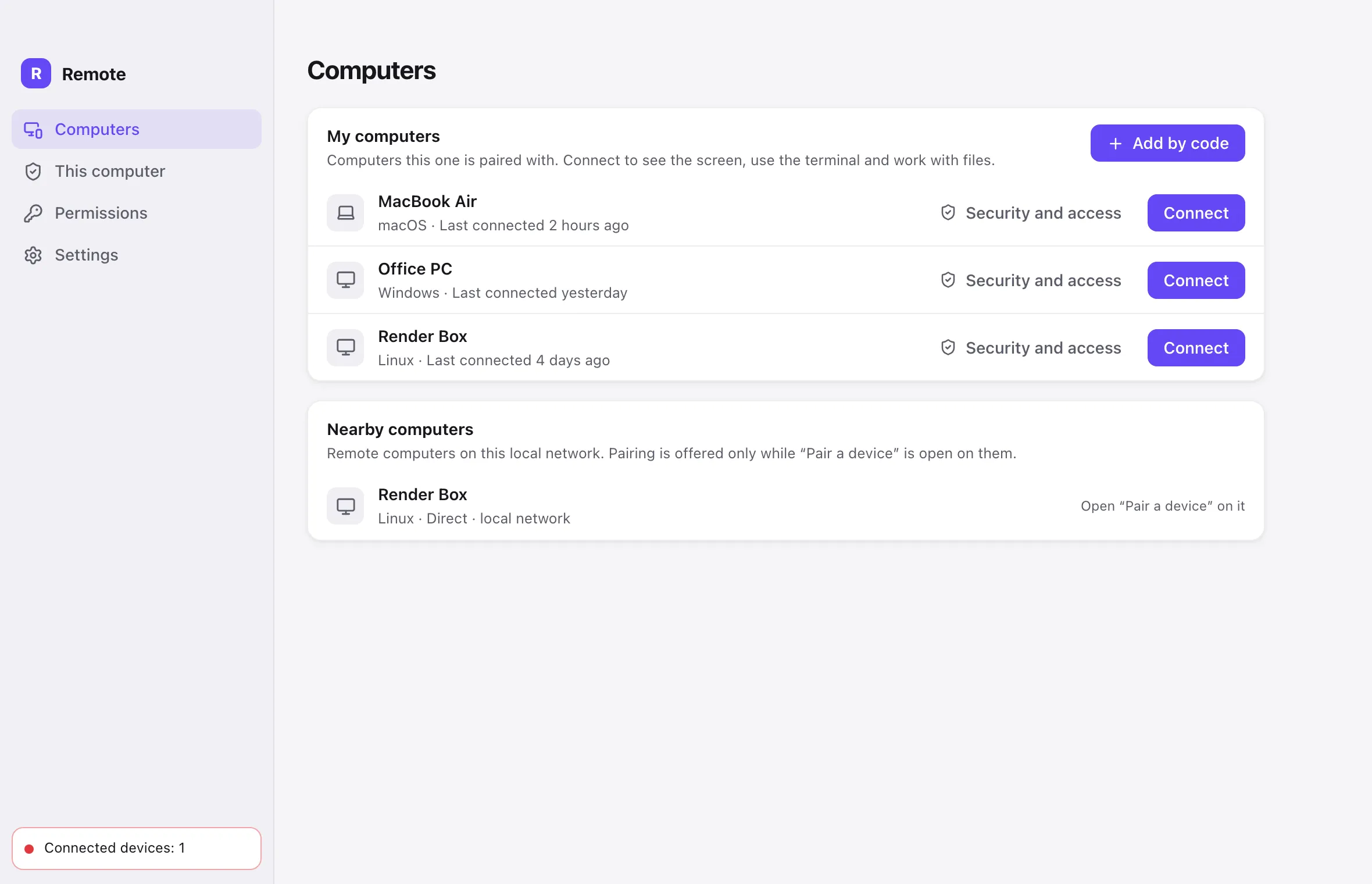
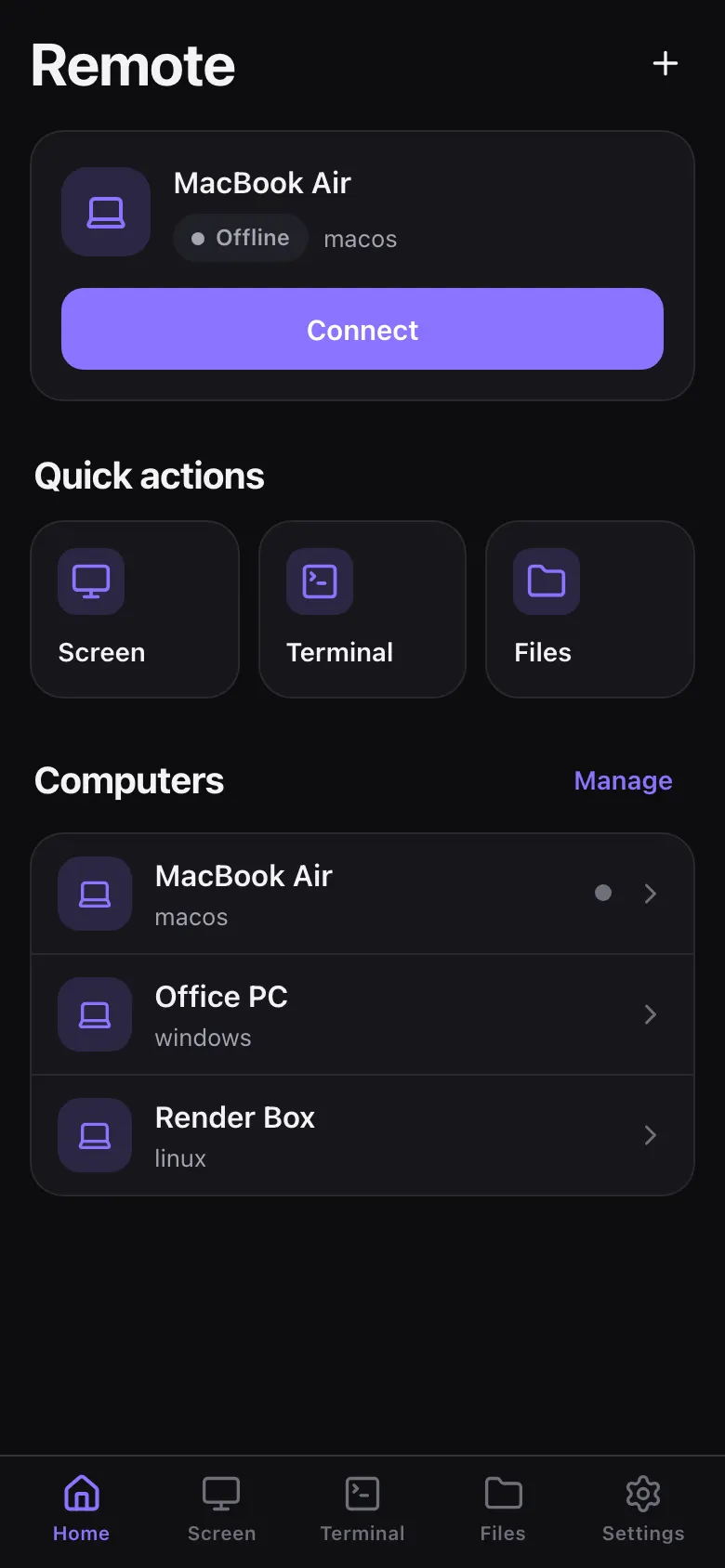
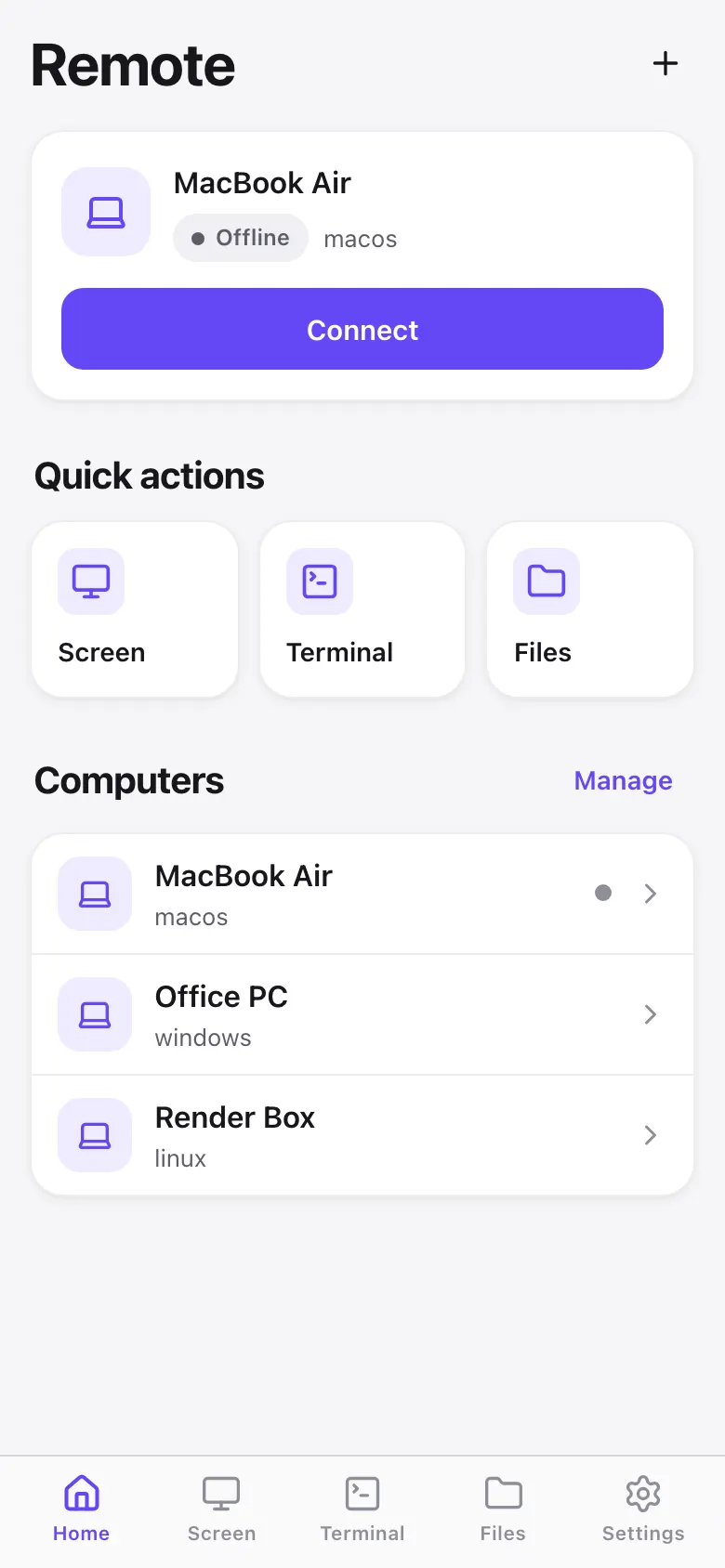
See the screen, type, run a terminal and move files on your own computers — from another computer or your iPhone. End-to-end encrypted, between devices you paired yourself.
How it works
Remote connects your devices directly. There is nothing to sign up for and no cloud dashboard to trust.
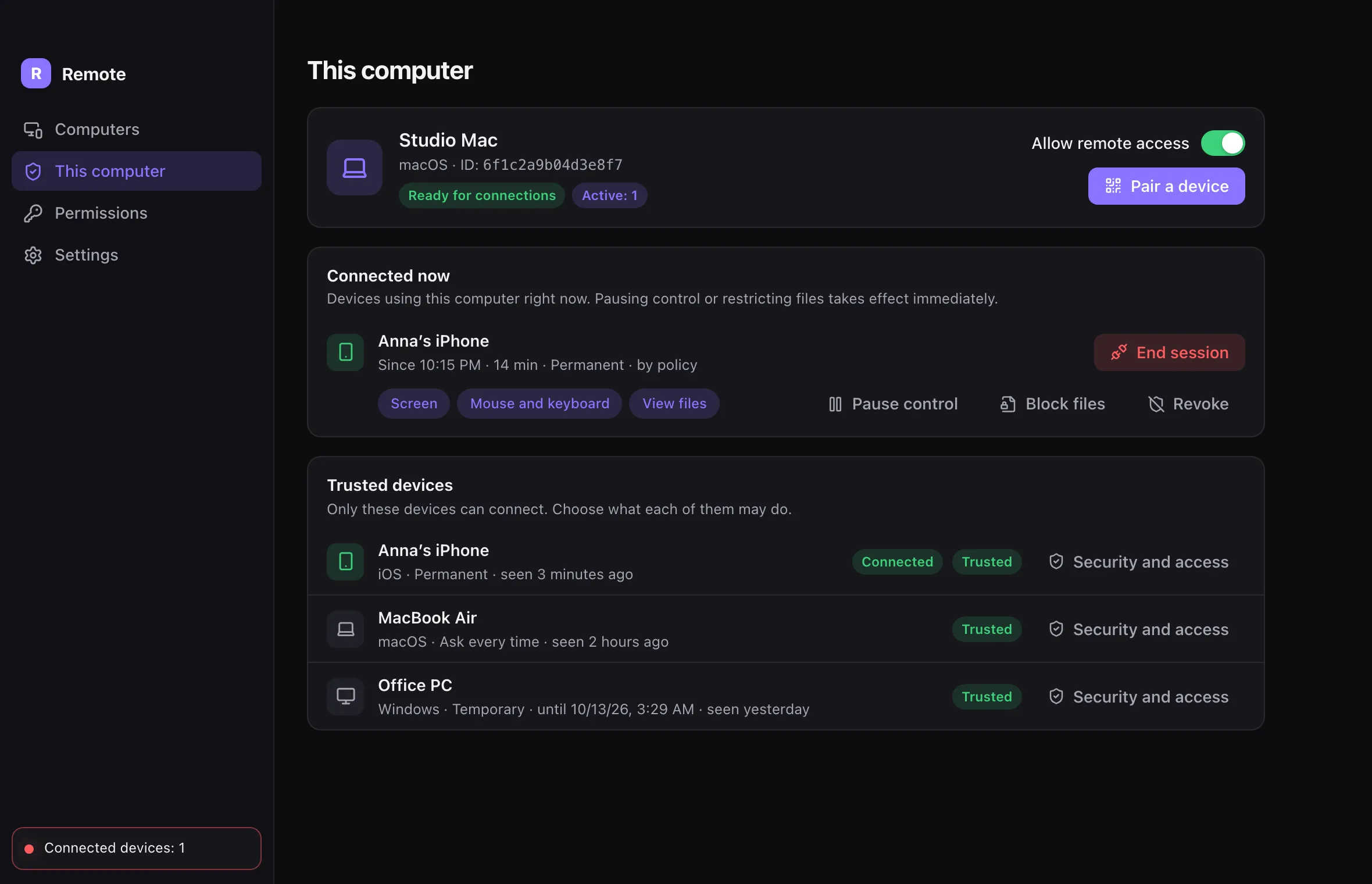
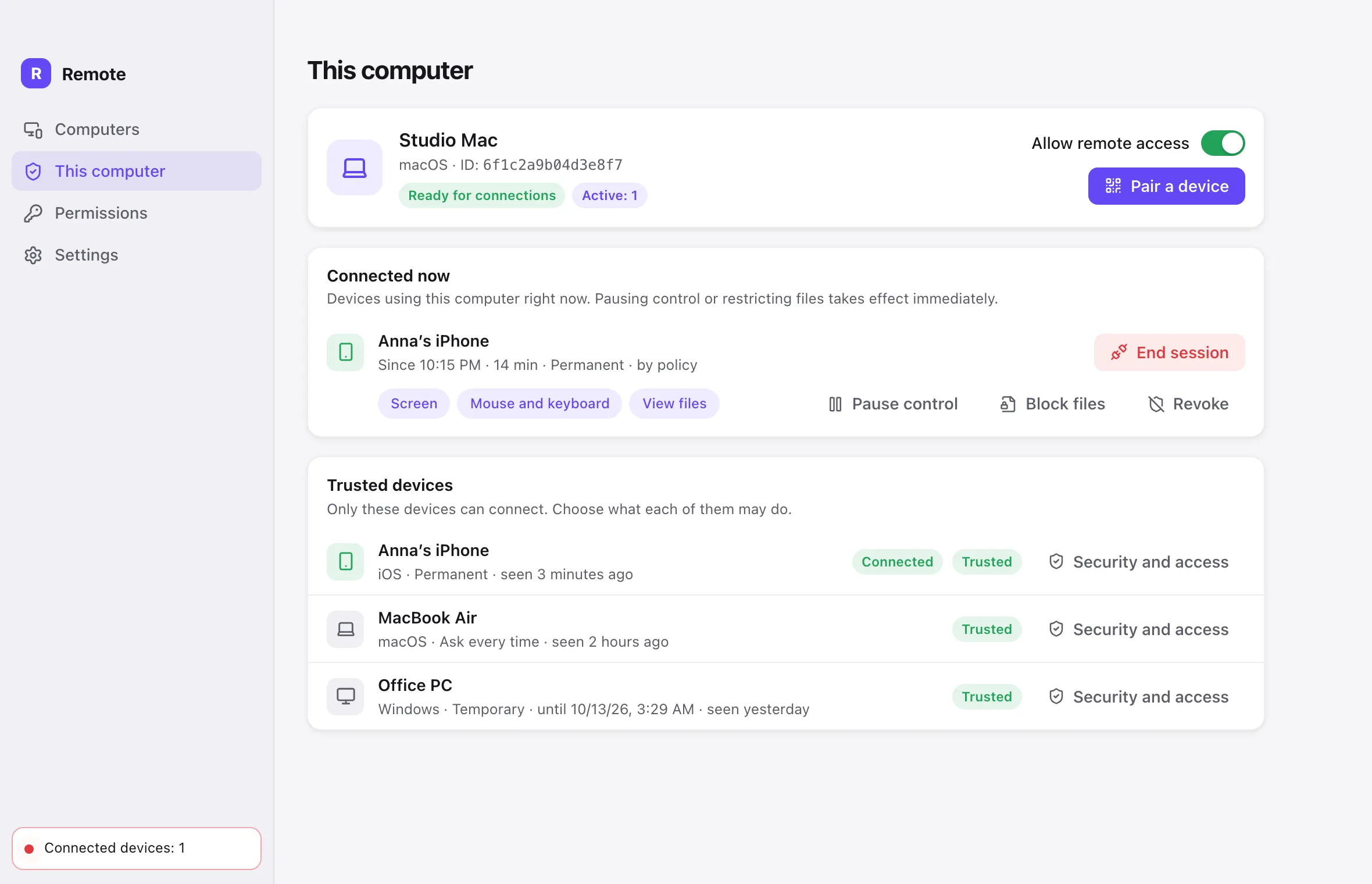
Every desktop installation is both a host and a controller: it can be controlled, and it can control your other computers.
The code is single-use and expires in five minutes. Both devices show the same six-digit code, and you approve the pairing on the computer itself.
Open the live screen with keyboard and mouse, a terminal or the files — from a computer or from your iPhone.
Features
Pick the quality that fits the moment, switch between displays, and send or fetch the clipboard.
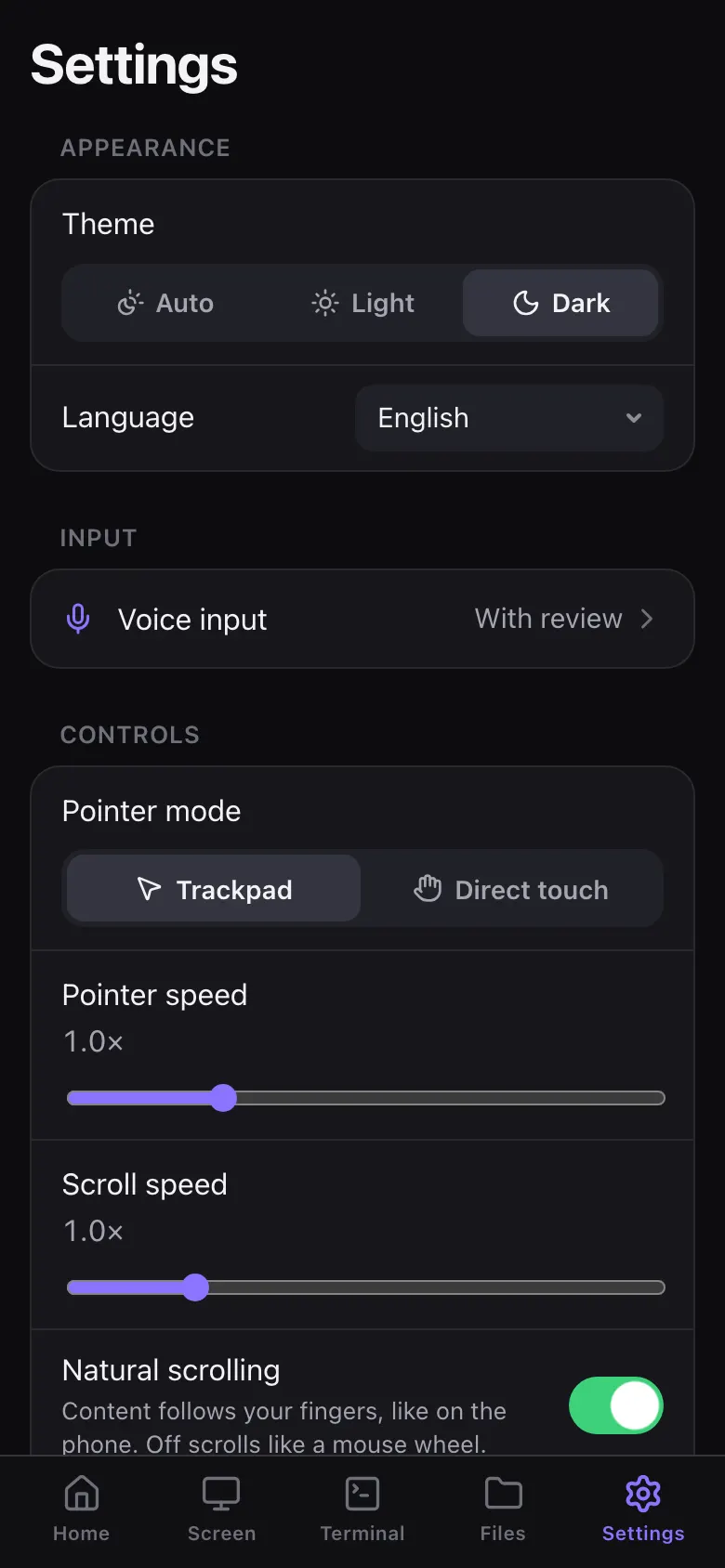
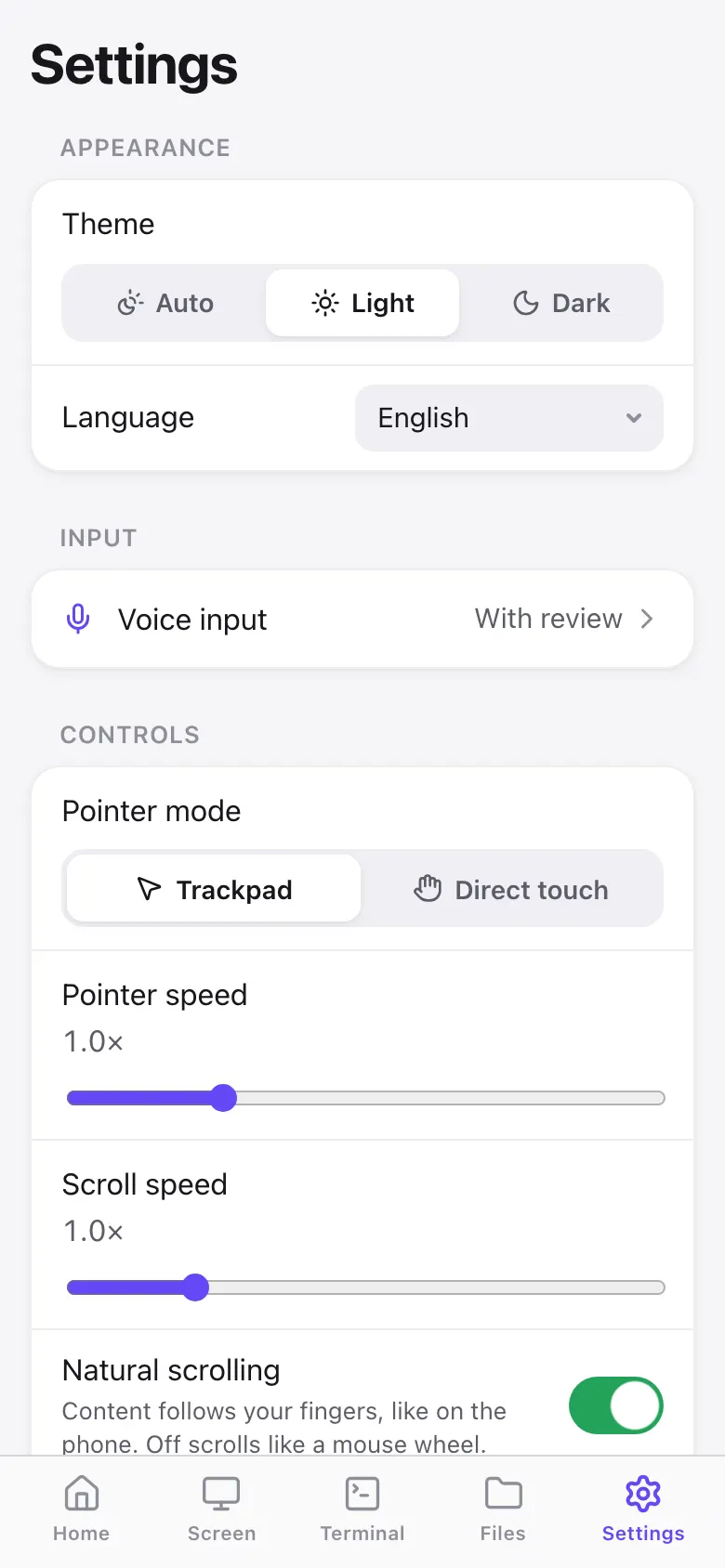
Use it as a trackpad or touch the screen directly. Dictate text with Apple speech recognition or an on-device Whisper model.
A full shell on the remote computer — not a list of canned commands.
Browse, upload, preview PDFs and images, and edit text files with conflict detection. Deleted items go to the Trash.
Keep connections to different computers open at once.
Swap ⌘ and Ctrl between Mac and PC.
Notes about each computer, stored only on your device.
The whole interface, including every security text.
Platforms
We publish exactly what works today. Windows and Linux are implemented and are being tested on real machines.
Host & controller
Verified on real hardware, with hardware H.264 encoding through VideoToolbox.
Host & controller
Windows 10 or 11 with WebView2.
Host & controller
X11, or Wayland through the screen-sharing portal.
Controller
Controls your Mac, Windows and Linux computers.
Android is not available.
Security & privacy
Remote uses standard, well-reviewed cryptography from audited libraries — it doesn’t invent its own ciphers.
A relay can see
It never sees
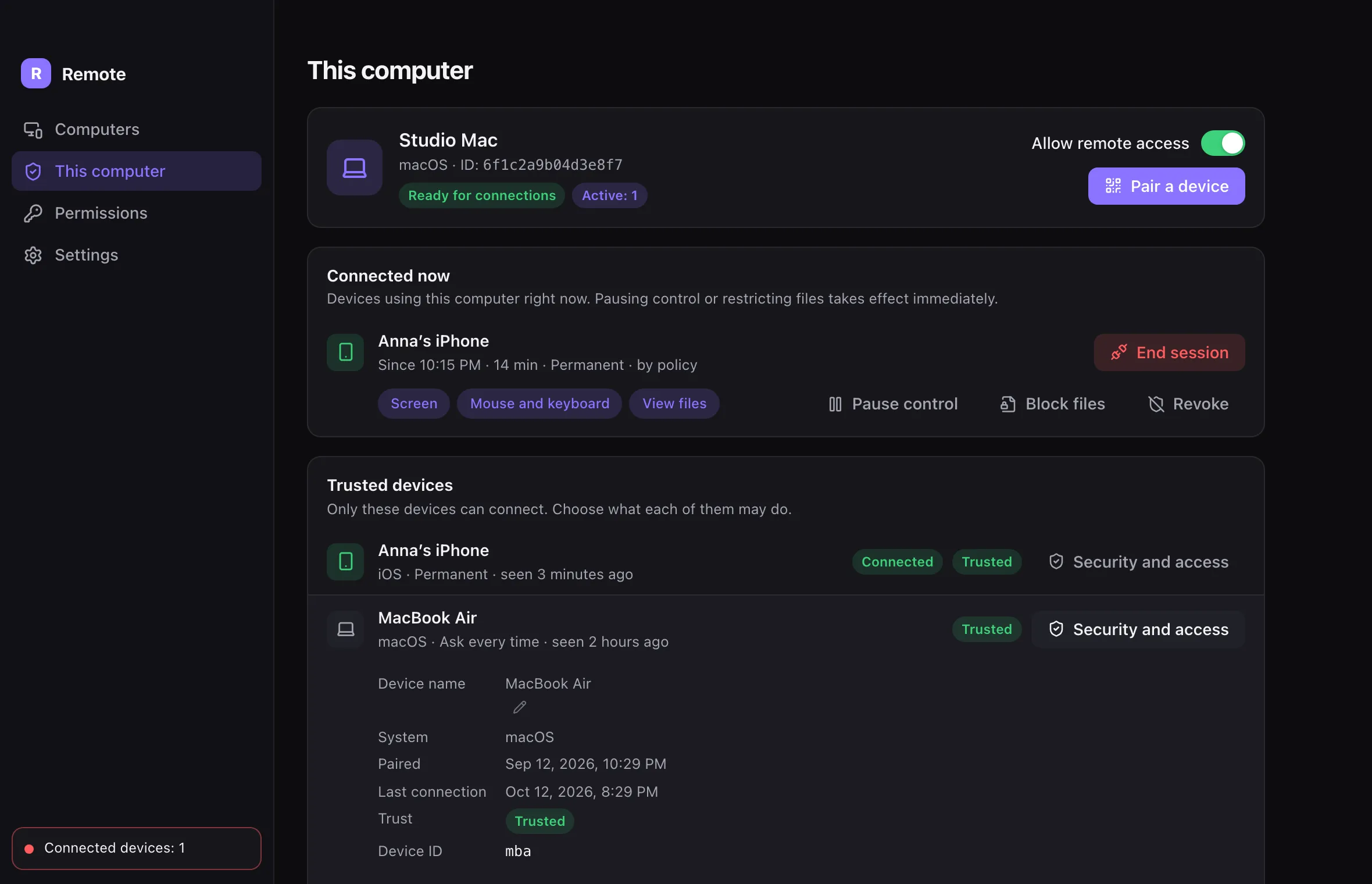
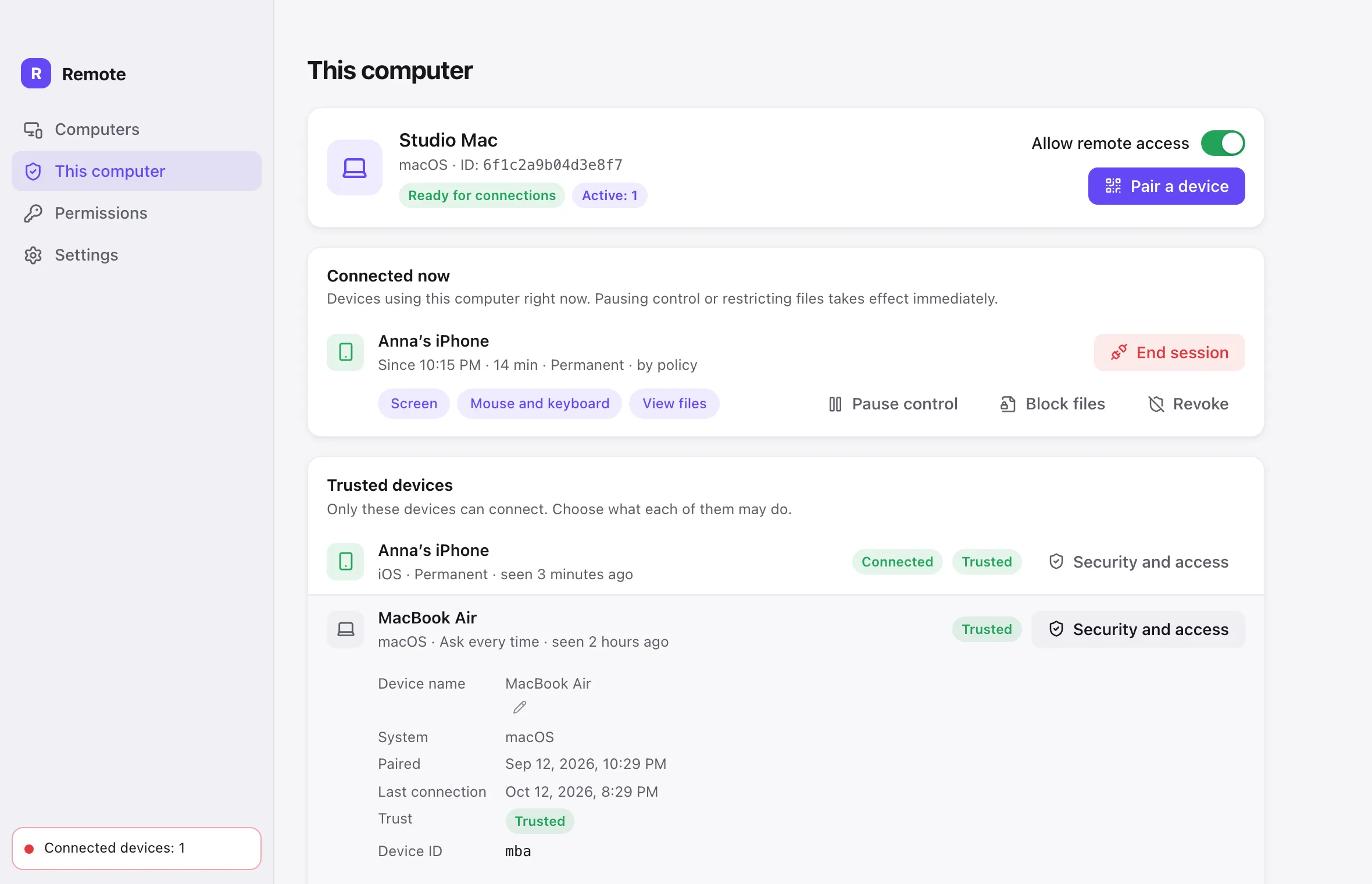
Each installation creates its own Ed25519 and X25519 keys, stored in Keychain, Credential Manager or Secret Service.
A random 256-bit single-use token that expires in five minutes, a six-digit code to compare, and approval on the host.
Signaling is sealed with X25519, HKDF and XChaCha20-Poly1305. Relays forward messages they cannot read.
Screen and data travel over WebRTC DTLS-SRTP, cryptographically tied to the identities you paired.
Screen, input, apps, terminal, reading files and writing files — checked on every request, revocable at any moment.
Permanent, ask every time, or temporary access, with a limit on how long a session may last.
See who connected and when. Connection history keeps metadata only.
On iPhone, Remote can ask for Face ID or Touch ID before every connection.
Remote has extensive automated security tests but has not had an independent third-party audit yet. We will say so here until it has.
Use cases
Check on a long export or close an app on your Mac — right from your iPhone.
Open a terminal on the computer in the other room and run the command there.
Grab the document you left on the other computer without emailing it to yourself.
Give a family computer “ask every time” access, so nothing happens without a yes.
Download
Remote is in development. Public, signed builds will be published here — until then there is nothing to download.
Mac with Screen Recording and Accessibility permissions
Windows 10 or 11 with WebView2
X11, or Wayland with xdg-desktop-portal
Controls your computers
FAQ
No. Devices pair directly with a QR code or a link. There is no account, sign-in or cloud dashboard.
Remote works on your local network out of the box — each desktop app includes its own relay and finds nearby computers automatically. Connecting over the internet needs a public signaling server and a TURN server; this can be configured in Settings → Network, but it is still being tested.
No. Relays only forward end-to-end encrypted messages. A relay can see technical metadata such as device IDs, IP addresses and traffic timing, but not your screen, input, terminal, files or pairing codes.
macOS has been verified on real hardware as both host and controller. Windows and Linux are implemented and are being tested. The iPhone app works as a controller. There is no Android app.
Yes. Every paired device has six separate permissions — screen, input, apps, terminal, reading files and writing files — and an access mode: permanent, ask every time, or temporary. Changes apply to open sessions immediately.
Not yet. Remote is covered by automated security tests, including forged identities, tampering, permission checks and path traversal, but no independent third-party audit has been performed.
No. There are no language models or agents in Remote. Dictation on iPhone only turns your speech into typed text.
Follow along as Remote gets ready for release.